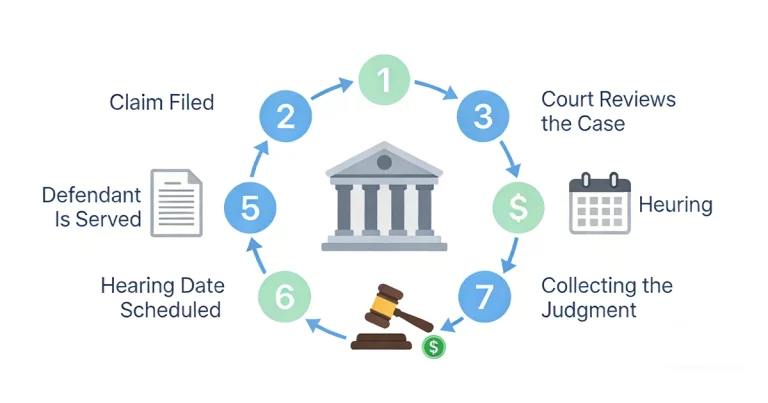
A Realistic Timeline for Most People
If you’re searching this, you’re probably not looking for legal theory.
You want to know something much more practical:
How long will this take in real life—and how much time will I actually need to set aside?
Here’s the short, honest answer most court websites don’t give you.California Small Claims Court Guide for Tenants & Landlords (2026)
By Emily Carter, J.D., Legal Content Editor at LawAbs
For a full overview of what happens after filing, see our guide on 👉what happens after you file a small claims case in California.
Table of Contents
The One-Sentence Answer Most People Remember
For most people in California, a small claims case takes about two months, requires one short court visit, and does not turn into a long, drawn-out process.
That’s the realistic expectation in the majority of cases.
Now let’s explain why—and when it can be different.
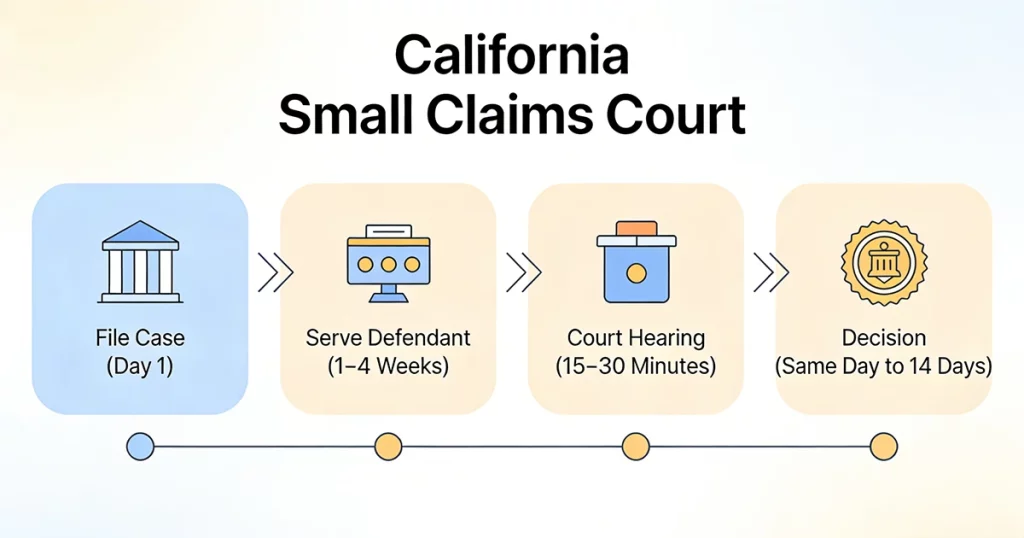
The Typical Timeline (What Usually Happens)
Most California small claims cases fall into this pattern:
File the case → serve the defendant → attend one hearing → receive a decision
From start to finish, this usually takes 6 to 10 weeks.
The process feels slower on paper than it does in real life because most of the time is simply waiting for scheduled dates.
What the Timeline Actually Looks Like, Step by Step
1. Filing the Case (Day 1)
Filing is straightforward. Once the court accepts your paperwork, the case officially begins.
This step rarely causes delays.
2. Serving the Defendant (1–4 Weeks)
This is the single biggest factor that affects how long your case takes.
If the defendant is served successfully on the first attempt, your case stays on track.
If service fails—because of an outdated address or missed delivery attempts—weeks can be added without warning.
In practice, service issues are the most common reason small claims cases take longer than expected.
3. Waiting for the Hearing Date (About 30–70 Days After Filing)
After service is completed, the court schedules a hearing.
Most California courts set small claims hearings one to two months out, depending on:
- The county
- Court workload
- Seasonal congestion (holidays and summer calendars matter more than people expect)
4. The Hearing (Usually One Short Visit)
This is what most people worry about—and it’s usually brief.
In most situations, you will not need to return to court again.
5. Receiving the Decision (Same Day to About 2 Weeks)
Some judges issue a decision immediately.
Others mail the decision within 7–14 days.
Waiting for the decision is normal, even when the hearing itself was short.
Which Timeline Are You Most Likely In?
This is the part that helps people plan their lives.
You’re likely in the typical 6–10 week timeline if:
- The defendant lives or works in California
- You have a current, accurate address
- You’re not requesting a postponement
Your case may take longer than average if:
- Service has already failed once
- The defendant avoids contact
- You filed close to major holidays
- The court calendar is unusually congested
Most cases fall into the first category.
Will You Need to Take Time Off Work?
Yes—but usually not much.
In most cases:
- You’ll need one half-day or one full day off for the hearing
- Multiple court appearances are uncommon
Extended time off is the exception, not the rule.
Why Some Small Claims Cases Take More Than Two Months
When delays happen, they’re usually caused by:
- Improper or delayed service
- Postponements requested by either party
- Court scheduling backlogs
These issues typically add weeks, not years—but they can feel stressful if you weren’t expecting them.
What You Can Do Right Now to Avoid Delays
Before your hearing date is set, it helps to double-check a few basics:
- The defendant’s address is current
- Service was completed correctly and on time
- Your paperwork matches the claim you filed
Small details early on can prevent unnecessary delays later.
After the Case Ends, Is It Really Over?
A court decision ends the case—but payment is a separate issue.
If the other side does not pay voluntarily, additional steps may be required, and those follow a different timeline entirely.
Understanding this early prevents frustration after you receive a judgment.
Bottom Line
If you’re planning around work, travel, or personal obligations, here’s the takeaway most people need:
Expect about two months.
Plan for one short court visit.
And don’t assume the process will take over your life.
California small claims court is designed to move relatively quickly—and in most cases, it does.
Related Reading
For a full process overview, see our guide on what happens after you file a small claims case in California.
This article is for general informational purposes only and does not provide legal advice.
Author Bio
Emily Carter, J.D., focuses on landlord–tenant disputes and small claims court procedures in California. She helps renters and property owners understand their legal options clearly and realistically. Emily’s goal is to make the legal process approachable and stress-free, giving Californians confidence every step of the way.